
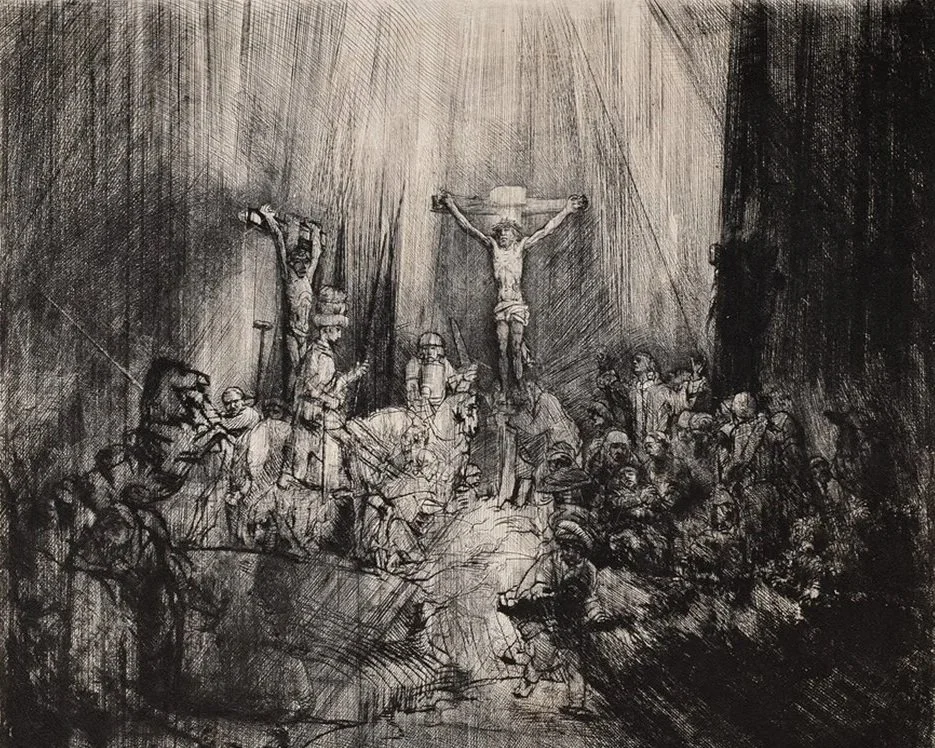
“[Shame is] the feeling that tells us we are not enough and that we are unworthy of love and belonging…[it’s] the emotional weapon that evil uses to corrupt our relationships with God and each other and disintegrate any and all gifts of vocational vision and creativity.”
— Dr. Curt Thompson
Therefore, since we are surrounded by such a great cloud of witnesses, let us throw off everything that hinders and the sin that so easily entangles. And let us run with perseverance the race marked out for us, fixing our eyes on Jesus, the pioneer and perfecter of faith. For the joy set before him he endured the cross, scorning its shame, and sat down at the right hand of the throne of God. Consider him who endured such opposition from sinners, so that you will not grow weary and lose heart.
(Hebrews 12v1-3, emphasis added)
We serve a God who can identify with us in our shame and our scorn.
A God not of mockery, but a God who has been repeatedly, routinely mocked.
A God who understands the pain and brutality of life here on earth.
A God who knows what it's like to be betrayed.
A God who has experienced rejection and despair.
A God who has endured the crucible of death.
…and…a God who has overcome it all.
This God offers us a way to face our shame, to move forward in freedom, and to experience new life.
But the journey we must embark on is not without difficulty and effort. It will require something of us. Not something we must do on our own, but something we do in response to what He has first done Himself. Something we do in partnership with the God of the universe, who came to this earth and entered our shame not to condemn us, but to redeem us.
Look at Rembrandt’s painting above. See this King of Kings and Lord of Lords perched upon His throne: a cross.
His court is flanked on the left and right not by princes, but by robbers.
And the people He looks out over are betrayers who jeered at Him and cheered on His execution.
Jesus on the cross meets us in our own moments of exposure and vulnerability.
Perhaps we can remember times when we were brought to a place of great embarrassment and humiliation. The proverbial nightmare of standing naked before a crowd came true, maybe not literally, but actually.
It was that time when your deepest secret, your greatest pain, or your darkest sin was exposed for the world to see. And above you there seemed to hang a written notice:
"Here lies the adulterer, the addict, the embezzler, the liar, the _____."
As your name and identity are slandered, the mob comes out and jeers, "Come on, save yourself."
Insult after insult. And there's nowhere to run and nowhere to hide.
Imagine Jesus with you here.
In the humiliation.
In the exposure.
In the embarrassment.
Let Jesus meet you there, and let the cost of the cross wash over you and begin its healing work.
We ought to lament that the cross was even necessary in the first place.
The cross was given because of what humanity had taken.
We took from the tree of knowledge of good and evil rather than trusting God.
We took wealth, sex, power, and more into our own hands instead of entrusting them to the hands who made them.
We took Satan’s lies in place of God’s truth.
And for all of time, we have been reaping the consequences.
There are no innocent parties here.
For all have sinned and fall short of the glory of God. (Romans 3v23)
Genuine interpretation demands real participation. We are all in this story. In every scene and in every movement—contributing to the brokenness, the pain, and the shame.
…but…
But the beauty of the cross is that the shame that’s so often attached to our failures was nailed there with Jesus too.
This is the beauty of the cross. In God’s grace, he sent His Son, Jesus, to pay that price on our behalf.
The cross is the declaration that Jesus is Lord not just over our failure but over the shame attached to our failure. And he invites us to—rather than avoid our shame—offer it to Him to be transformed.
The psychologist, David Banner writes that, “Transformation demands that we meet God in the vulnerability of our sin and shame rather than retreating to try to get on with our self-improvement projects. But it also requires that we stay long enough in his loving presence to allow our shame to begin to melt away. For love to transform us, not only must we meet it in vulnerability, we must also linger long enough for it to penetrate our woundedness.”
Embracing failure often means encountering shame. But what we do next is up to us.
We can transfer it and become perpetually anxious individuals who fearfully avoid risk and faith-filled action. Or, we can be transformed by an encounter with Jesus, the Great Healer, who melts away our shame and embraces us in love, freeing us to be and become all we were truly meant to be.
This implies that not only will we find ourselves in the story on the side of Pilate, the soldiers, the cross, the darkness, or the grave. No, what this implies is that we will find ourselves on the side of Jesus in this story.
Not only are we the priests, the prefect, and the people in this scene, we are—first and foremost—sons and daughters of the King, co-heirs and co-rulers with Christ!
Which means:
We will endure exploitation and manipulation by those seeking to gain, control, or keep power.
We will endure mockery, shame, and scorn by those who oppose us and hold us in contempt.
We will endure death—death to all that is wrong, sinful, and broken in our lives.
We will endure darkness—experiencing the seeming silence of God, unanswered prayer, and unsatisfactory outcomes.
And we will endure the grave—meeting an end that seems final, that seems hopeless.
But...this, we know, is not the end.
Thanks for reading,